
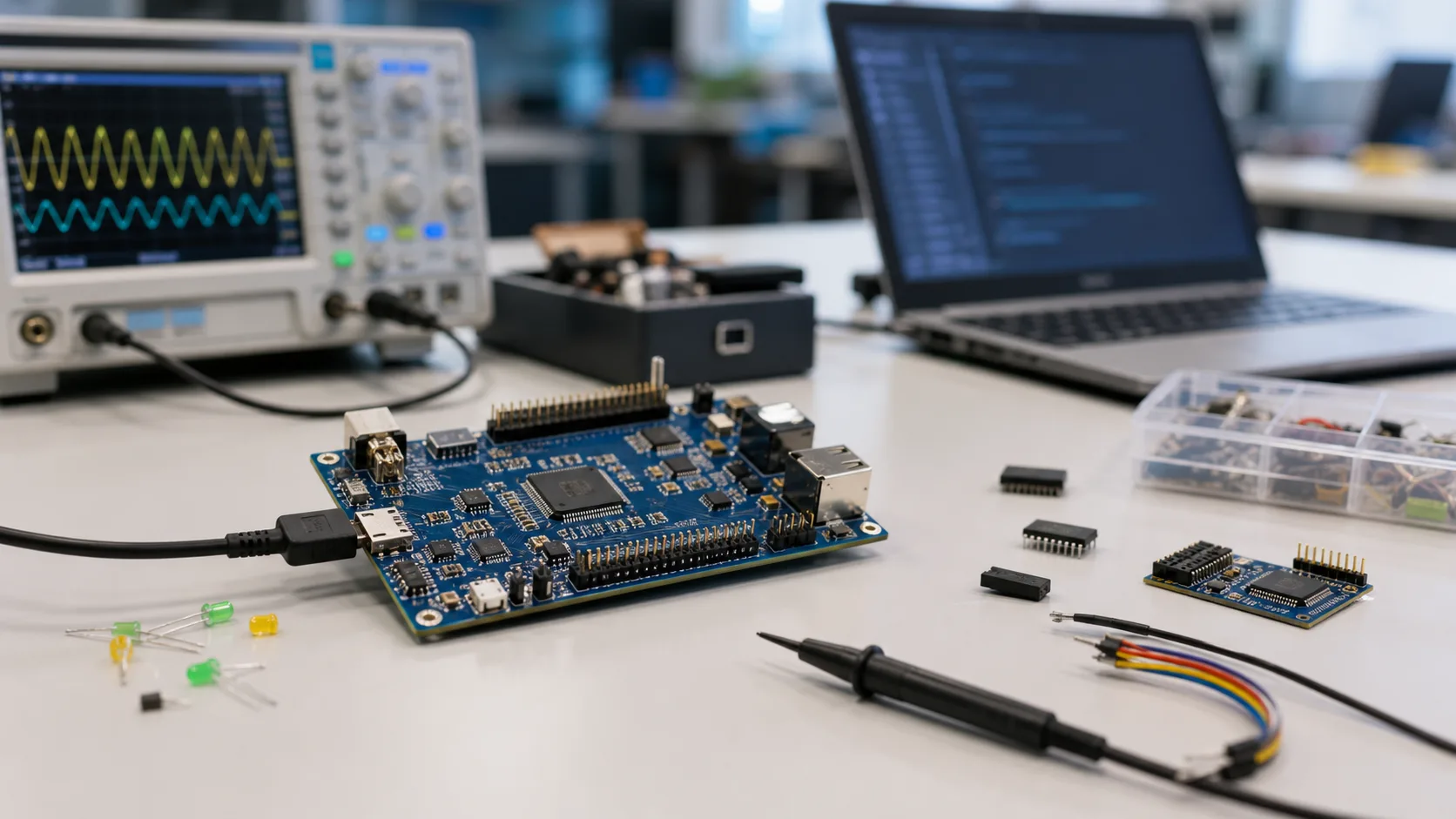
ARM architecture is one of the most widely used processor architectures in the world. It powers smartphones, tablets, embedded boards, industrial controllers, IoT devices, smart home products, automotive systems, and many single-board computers. In recent years, ARM has also expanded into laptops, servers, edge AI systems, and high-performance computing.
When people talk about an ARM processor, they are usually referring to a CPU based on the ARM instruction set architecture. This architecture defines how software instructions are understood and executed by the processor. Different chip companies can design their own ARM-based processors, but they follow the ARM instruction set so that operating systems, compilers, and applications can run on them.
ARM is especially important in embedded systems because it offers a strong balance between performance, power efficiency, cost, and integration flexibility. Many industrial devices, Android SBCs, Linux SBCs, HMI panels, routers, cameras, medical devices, and control terminals use ARM-based chips as their main computing platform.
What Does ARM Mean?
ARM originally stood for Acorn RISC Machine and later became Advanced RISC Machine. Today, ARM is best understood as a processor architecture family based on the RISC design philosophy.
RISC means Reduced Instruction Set Computing. A RISC processor uses relatively simple instructions that can be executed efficiently. Instead of using very complex instructions at the CPU level, RISC architectures usually rely on simpler instructions and efficient compiler optimization.
This design philosophy helps ARM processors achieve good performance with lower power consumption. That is one of the main reasons ARM became dominant in mobile and embedded devices.
It is important to understand that ARM is not just one processor model. ARM is an architecture. Many companies build processors based on ARM architecture. For example, Qualcomm, Apple, MediaTek, Samsung, Rockchip, NXP, STMicroelectronics, Allwinner, and many other chip companies use ARM cores or ARM instruction sets in their SoCs.
ARM Architecture vs ARM Processor
ARM architecture and ARM processor are related but not exactly the same.
ARM architecture refers to the instruction set and design rules that define how the processor works from a software point of view. It includes instructions, registers, execution modes, memory behavior, exception handling, and other low-level details.
An ARM processor is a physical CPU implementation based on that architecture. For example, Cortex-A53, Cortex-A55, Cortex-A72, Cortex-A76, Cortex-A78, Cortex-A510, Cortex-A710, and Cortex-A715 are ARM CPU cores. Chip vendors can license these cores or design compatible cores based on ARM architecture.
An SoC, or system-on-chip, usually includes one or more ARM CPU cores plus many other hardware blocks. These may include GPU, memory controller, display controller, video decoder, image processor, USB, Ethernet, PCIe, UART, SPI, I2C, GPIO, AI accelerator, and power management logic.
For example, a Rockchip or NXP processor used in an embedded SBC is usually an ARM-based SoC. The ARM CPU is only one part of the chip, but it is the part that runs the operating system and main software.
Why ARM Is Popular
ARM became popular because it provides a strong combination of performance and power efficiency. In battery-powered devices, power consumption is extremely important. Smartphones, tablets, handheld terminals, wearable devices, and IoT products all need processors that can perform well without consuming too much energy.
ARM processors are also highly scalable. Small ARM Cortex-M microcontrollers can run simple embedded firmware with very low power consumption. Larger Cortex-A processors can run Linux, Android, and complex applications. High-end ARM processors can power laptops and servers.
This scalability makes ARM useful across many product categories. The same general architecture family can support a tiny sensor device, a smart control panel, a Linux SBC, an Android tablet, an industrial gateway, and a cloud server.
Another reason ARM is popular is the licensing model. ARM Holdings designs CPU architectures and cores, then licenses them to semiconductor companies. These companies can build their own chips for different markets. This has created a very large ecosystem of ARM-based SoCs.
RISC Design and Power Efficiency
ARM is based on RISC principles. RISC processors generally use simpler instructions, a load-store architecture, and efficient pipelining. This means that many operations are performed in a more predictable and power-efficient way.
A load-store architecture means that data is usually loaded from memory into registers before processing, and then stored back to memory after processing. Arithmetic and logic operations mainly happen inside CPU registers. This can simplify CPU design and improve efficiency.
Power efficiency is one of ARM’s strongest advantages. In many embedded systems, the processor may need to run continuously for years, or it may need to operate inside a sealed enclosure with limited heat dissipation. A lower-power processor reduces heat, improves reliability, and makes the power supply design easier. Those same characteristics explain why ARM SoCs are common in low-power industrial applications, especially when the product is sealed, compact, or powered from a limited energy budget.
This is why ARM architecture is widely used in industrial control panels, smart home devices, network equipment, battery-powered terminals, portable medical devices, and embedded Linux systems.
ARM Core Families
ARM processors are often divided into different core families. Each family is designed for different performance and power requirements.
Cortex-A
Cortex-A cores are application processors. They are designed to run rich operating systems such as Linux and Android. These cores are used in smartphones, tablets, SBCs, industrial computers, smart displays, automotive systems, and edge devices.
Examples include Cortex-A7, Cortex-A53, Cortex-A55, Cortex-A72, Cortex-A73, Cortex-A76, Cortex-A78, and newer ARMv9 cores. Many embedded SBCs use Cortex-A cores because they need to run a full operating system, graphical interface, network services, and user applications.
Cortex-R
Cortex-R cores are real-time processors. They are designed for applications that require predictable response and high reliability. They are used in automotive systems, storage controllers, industrial control, and safety-related applications.
Cortex-R processors are not as common in general-purpose SBC products, but they are important in systems where real-time behavior matters.
Cortex-M
Cortex-M cores are microcontroller cores. They are designed for low-power embedded control. They are commonly used in sensors, motor control, simple IoT devices, consumer electronics, industrial modules, and low-cost embedded systems.
Examples include Cortex-M0, Cortex-M3, Cortex-M4, Cortex-M7, Cortex-M23, and Cortex-M33. These processors usually run bare-metal firmware or real-time operating systems instead of full Linux or Android.
ARMv7, ARMv8, and ARMv9
ARM architecture has evolved over many generations. Some common architecture versions include ARMv7, ARMv8, and ARMv9.
ARMv7 was widely used in earlier smartphones, embedded boards, and industrial devices. Many ARMv7 processors are 32-bit. They can run Linux and Android, but they are less common in new high-performance products.
ARMv8 introduced 64-bit support through AArch64. This was a major step because it allowed ARM processors to address more memory and run more modern software stacks. Many current embedded SoCs use ARMv8-A cores such as Cortex-A53, Cortex-A55, Cortex-A72, and Cortex-A76.
ARMv9 is a newer generation focused on performance, security, AI, and modern computing requirements. It is used in newer mobile processors, high-performance embedded platforms, and server-class ARM chips.
For embedded product developers, ARMv8 is currently very common because it supports 64-bit Linux and Android while maintaining good power efficiency.
32-Bit ARM and 64-Bit ARM
ARM processors can be 32-bit or 64-bit, depending on the architecture and core.
A 32-bit ARM processor can address less memory and usually runs 32-bit operating systems and applications. It may still be suitable for simple embedded products, microcontrollers, or cost-sensitive systems.
A 64-bit ARM processor can handle larger memory spaces and modern software environments more efficiently. Most current Android devices and many Linux SBCs use 64-bit ARM processors. For applications that need more RAM, stronger performance, modern security features, or long-term software support, 64-bit ARM is usually preferred.
In embedded systems, the choice between 32-bit and 64-bit depends on application requirements. A simple controller may not need 64-bit computing. But an Android HMI, industrial gateway, AI camera, or edge computing device usually benefits from a 64-bit ARM platform.
ARM in SoC Design
ARM processors are often used inside SoCs. An SoC integrates the CPU with many other components on a single chip. This is different from traditional PC architectures where many functions may be handled by separate chips.
A typical ARM-based SoC may include:
- ARM CPU cores
- GPU
- Memory controller
- Display controller
- Video encoder and decoder
- Image signal processor
- AI accelerator or NPU
- Ethernet controller
- USB controller
- PCIe interface
- UART, SPI, I2C, and GPIO
- Audio interfaces
- Security engine
- Power management logic
This high level of integration is very useful for embedded products. It reduces board size, lowers power consumption, simplifies hardware design, and reduces system cost.
For example, an Android SBC for HMI may use an ARM SoC to drive the display, process touch input, run Android, handle Wi-Fi or Ethernet, decode video, and communicate with external devices. A Linux SBC for industrial control may use an ARM SoC to run Linux services, manage RS485 communication, collect data, and provide a web interface.
ARM and Embedded Systems
ARM is one of the most important architectures in embedded systems. Embedded devices need processors that are compact, power-efficient, reliable, and cost-effective. ARM fits these requirements very well.
In embedded Linux systems, ARM processors are used to run full operating systems on compact hardware. These systems can support networking, file systems, graphical interfaces, industrial protocols, and cloud communication.
In Android embedded systems, ARM processors are used in smart displays, HMI panels, retail terminals, medical devices, and control panels. Android itself is widely optimized for ARM hardware.
In microcontroller systems, Cortex-M processors are used for direct hardware control, sensor reading, motor control, low-power IoT devices, and real-time tasks.
Because ARM covers such a wide range of performance levels, engineers can choose a processor that matches the product requirement instead of using a one-size-fits-all platform.
ARM vs x86
ARM and x86 are two major processor architectures. x86 is commonly used in desktop PCs, laptops, servers, and industrial PCs. ARM is widely used in mobile devices, embedded systems, and increasingly in laptops and servers.
The main difference is historical design direction. x86 processors were traditionally optimized for high performance and broad software compatibility in PCs. ARM processors were traditionally optimized for power efficiency and embedded integration.
ARM processors often have lower power consumption and better integration for embedded products. They are suitable for fanless devices, compact boards, battery-powered products, and systems with limited thermal space.
x86 processors usually have strong performance and excellent compatibility with traditional PC software. They are often used when a product needs standard desktop operating systems, legacy software, high computing performance, or industrial PC compatibility.
For industrial embedded products, ARM is often preferred when size, power, cost, and custom integration matter. x86 may be preferred when the system needs PC-class performance or compatibility with existing x86 software. At the product level, the ARM vs x86 decision for industrial SBCs depends less on the instruction set alone and more on software compatibility, thermal limits, lifecycle, and field support.
ARM and Operating Systems
ARM processors can run many types of operating systems, depending on the core family and hardware capability.
Cortex-M microcontrollers often run bare-metal firmware or real-time operating systems such as FreeRTOS, Zephyr, or RT-Thread. These systems are suitable for simple control and low-power operation.
Cortex-A processors can run Linux, Android, Debian, Ubuntu, Buildroot, Yocto, and other operating systems. These platforms are suitable for embedded computers, SBCs, gateways, HMI products, and smart terminals.
Some ARM systems also run real-time operating systems or mixed operating environments. For example, one core may run Linux while another real-time core handles deterministic control tasks.
This flexibility makes ARM suitable for many different product types, from tiny sensors to complex industrial computers.
ARM and Single-Board Computers
Many single-board computers use ARM processors because ARM SoCs integrate many features in a compact and affordable package. An ARM SBC may include CPU, GPU, RAM, storage, Ethernet, USB, HDMI, MIPI DSI, LVDS, GPIO, UART, SPI, I2C, Wi-Fi, Bluetooth, and other interfaces.
ARM SBCs are widely used in industrial control, HMI panels, IoT gateways, digital signage, medical equipment, smart home systems, robotics, and edge computing.
For Linux SBCs, ARM provides good performance with low power consumption. For Android SBCs, ARM is especially suitable because Android has long been optimized for ARM-based devices.
When selecting an ARM SBC, engineers usually consider CPU performance, RAM, eMMC, display support, industrial interfaces, Linux or Android BSP quality, thermal performance, long-term supply, and vendor support.
Big.LITTLE Architecture
Many modern ARM processors use a heterogeneous CPU design often known as big.LITTLE. This means the SoC combines high-performance CPU cores with low-power CPU cores.
The high-performance cores handle demanding tasks such as application loading, graphics processing support, web rendering, AI tasks, or complex computation. The low-power cores handle background tasks, light workloads, and standby operations.
This design improves energy efficiency. The system can use low-power cores when workload is light and switch to stronger cores when performance is needed.
For embedded systems, this can be useful because devices often have changing workloads. An HMI may stay idle most of the time, then need faster response when the user interacts with it. A gateway may run light monitoring tasks continuously but occasionally process large data transfers.
Advantages of ARM Architecture
ARM architecture has several important advantages.
First, it is power-efficient. This makes it suitable for battery-powered devices, fanless systems, and compact embedded products.
Second, it is scalable. ARM can be used in small microcontrollers, mid-range embedded processors, high-end mobile SoCs, and server-class chips.
Third, ARM SoCs are highly integrated. This reduces PCB complexity and helps build compact products.
Fourth, ARM has a large ecosystem. Linux, Android, compilers, drivers, development boards, middleware, and software tools are widely available.
Fifth, ARM supports custom SoC design. Chip vendors can build processors for specific markets, such as industrial control, smart displays, automotive systems, networking, or AI edge computing.
Limitations of ARM Architecture
ARM also has limitations that engineers should understand.
Software compatibility can be an issue when moving from x86 to ARM. Some desktop software or legacy industrial applications may only support x86. In such cases, porting or replacement may be required.
Hardware support depends heavily on the SoC vendor. Unlike standard PC platforms, ARM embedded boards often require vendor-specific kernels, device trees, bootloaders, and drivers. The quality of the BSP is very important.
Performance varies widely between ARM chips. A low-cost ARM processor and a high-end ARM processor may both be called ARM, but their real performance can be very different.
Long-term support should also be considered. Embedded products may need to remain in production for many years. Engineers should check SoC availability, software maintenance, kernel support, and vendor commitment before selecting a platform.
How to Choose an ARM Platform
When selecting an ARM platform for an embedded product, engineers should start from the product requirement.
Important factors include:
- Required operating system
- CPU performance
- GPU or display requirements
- RAM capacity
- Storage type and size
- Power consumption
- Operating temperature
- Display interfaces
- Camera interfaces
- Ethernet, USB, UART, SPI, I2C, GPIO, CAN, and RS485 support
- Linux or Android BSP quality
- Driver availability
- Security features
- Thermal design
- Long-term supply
- Vendor technical support
- Certification requirements
- Production testing support
For an Android HMI, display support, GPU performance, touch integration, Android BSP quality, and power management may be most important. For a Linux industrial controller, Ethernet, RS485, CAN, GPIO, kernel stability, and storage reliability may be more important.
The best ARM platform is not always the newest or fastest one. It is the platform that matches the technical, cost, software, and lifecycle requirements of the product.
Conclusion
ARM architecture is a processor architecture family built around power efficiency, scalability, and embedded integration. It is used in smartphones, tablets, SBCs, industrial devices, smart displays, IoT gateways, medical equipment, automotive systems, and many other products.
The strength of ARM comes from its flexible architecture and large ecosystem. Small Cortex-M processors can control sensors and motors. Cortex-A processors can run Linux and Android. High-end ARM chips can support AI, multimedia, edge computing, and even server workloads.
For embedded system designers, ARM provides many options. It can support simple control devices, Linux SBCs, Android HMI panels, industrial gateways, and advanced edge computing platforms. However, selecting an ARM platform requires careful evaluation of performance, power, interfaces, software support, thermal behavior, and long-term availability.
In modern embedded development, ARM architecture is not just a processor choice. It is a foundation for building compact, efficient, connected, and scalable electronic products.