
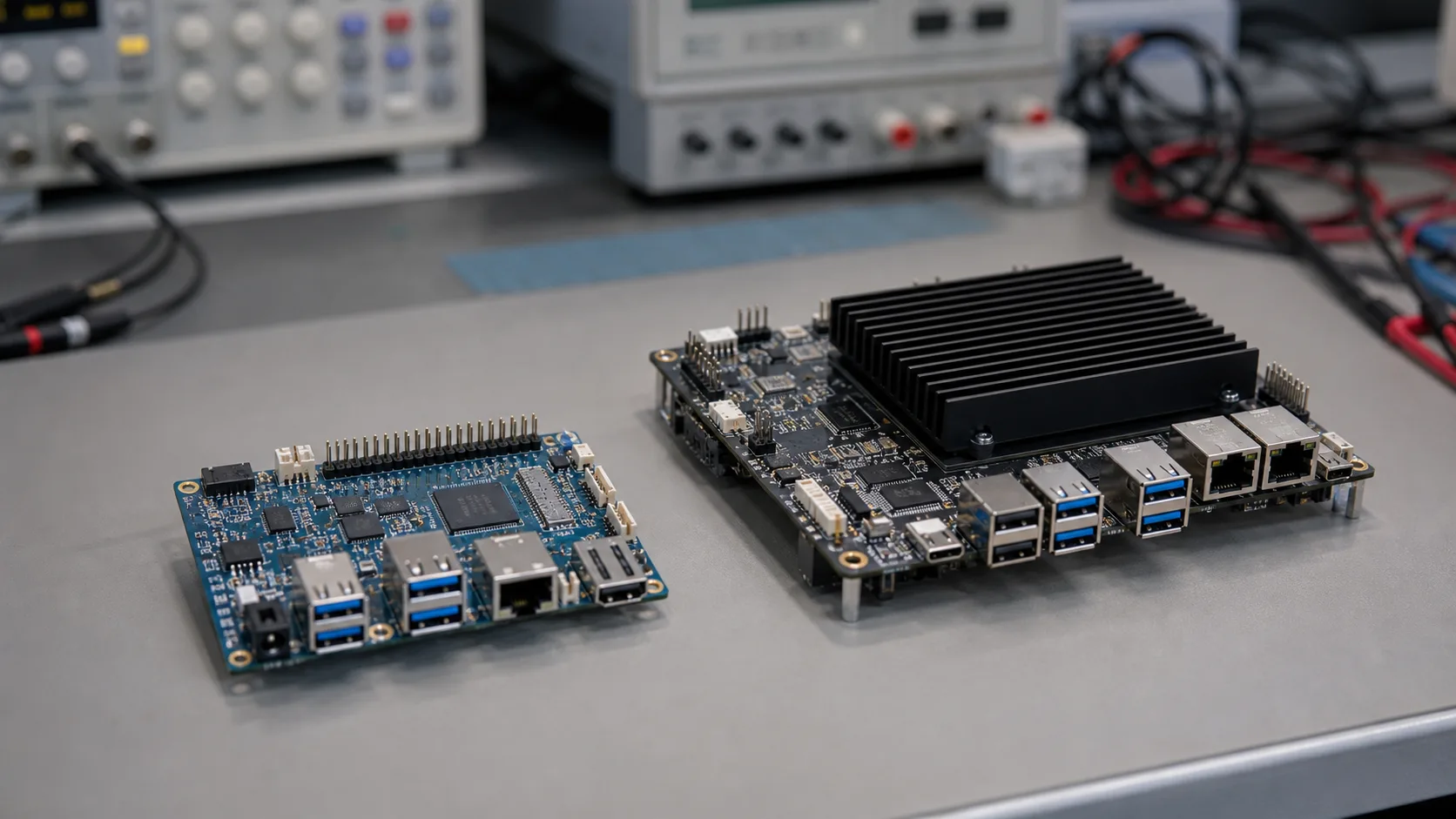
Rockchip RK3568 and RK3588 are often discussed together because both are ARM-based SoCs used in embedded boards, gateways, HMI panels, vision boxes, and compact industrial computers. In practice they serve different classes of product. RK3568 is the more conservative industrial choice when the system needs modest compute, low power, stable Linux support, and enough I/O for control and gateway work. RK3588 is the higher-performance platform for edge AI, multi-display systems, media processing, and workloads that can justify more thermal headroom.
The decision is not simply “newer is better.” A strong industrial SBC design starts with workload, enclosure, software, I/O, and supply requirements. A board that looks faster on paper may be harder to cool, more expensive to validate, or unnecessary for a product that mostly handles protocol conversion and a lightweight web interface.
Quick Comparison
| Area | RK3568 | RK3588 |
|---|---|---|
| Typical role | Gateway, HMI, controller, router-class SBC | Edge AI box, vision computer, multi-display HMI |
| CPU class | Quad Cortex-A55 class platform | 4x Cortex-A76 plus 4x Cortex-A55 class platform |
| AI capability | Light NPU workloads, depending on board and SDK | Much stronger NPU class, commonly used for object detection and vision |
| Display/media | Good for standard embedded displays | Better for 4K/8K media, multiple displays, richer UI |
| Power/thermal profile | Easier to cool passively | Needs more careful thermal design |
| Best fit | Cost-sensitive industrial products | Performance-sensitive edge products |
CPU Performance and System Responsiveness
RK3568 is suitable when the application stack is mostly I/O bound. Examples include Modbus gateways, MQTT edge nodes, simple HMI panels, equipment monitors, and Linux services that do not require heavy local analytics. A quad Cortex-A55 class processor can feel responsive when the software is lean, storage is not slow, and the UI is not overloaded with animations or browser-heavy dashboards. On this lower-power path, the real buying work is closer to a Rockchip RK3568 industrial board checklist than a CPU benchmark.
RK3588 moves into a different class. Its Cortex-A76 performance cores give it much better headroom for multi-process Linux systems, containerized services, local databases, video pipelines, and machine vision workloads. If your system needs to run a camera pipeline, inference process, local dashboard, remote update agent, and data logger at the same time, RK3588 is more forgiving. That is also why some teams move from module evaluation into a full custom industrial computer based on RK3588 when enclosure, I/O, and thermal integration become product-level decisions.
The mistake many teams make is buying RK3588 for every design because it feels safer. That can be wasteful. If the product will spend most of its life at 10 percent CPU utilization, RK3568 may deliver a better product because it reduces heat, BOM pressure, and enclosure complexity.
AI and Vision Workloads
For AI, RK3588 is the more capable platform. It is widely selected for object detection, people counting, defect inspection, visual analytics, and local inference demos. Its NPU ecosystem is not the same as NVIDIA CUDA or a desktop GPU workflow, so model conversion and runtime validation still matter, but the raw platform target is more appropriate for computer vision and edge AI gateway workloads.
RK3568 can still be useful for simpler AI tasks. It may handle basic detection, classification, or rule-assisted analytics if the model is small, frame rate is modest, and expectations are realistic. It is a poor fit if marketing requirements say “multi-camera AI” but the engineering requirement later becomes 1080p streams with low latency and continuous recording.
For an industrial SBC, AI selection should start with a test matrix:
| Test | Why it matters |
|---|---|
| Model conversion success | Some operators or layers may not map cleanly to the NPU runtime |
| Sustained FPS for 8 hours | Short demos hide thermal throttling and memory leaks |
| Camera-to-inference latency | Frame rate alone does not show control-loop delay |
| CPU usage during NPU load | Pre/post-processing may consume more CPU than expected |
| Recovery after camera disconnect | Field systems must survive bad cables and hot-plug events |
Display, Media, and HMI Design
RK3568 is a sensible platform for many industrial HMIs: single display, moderate resolution, touch input, local status UI, and a few background services. It can be paired with Android or Linux depending on vendor BSP support. If the HMI is essentially a kiosk-style interface, RK3568 can be enough.
RK3588 is better when the UI is more demanding. Multi-display output, 4K media playback, camera preview walls, 3D visualization, and browser-based dashboards all benefit from the larger CPU/GPU/media budget. In a control room or machine vision station, RK3588 can reduce the need for a separate PC.
The hidden issue is not only display output. It is memory bandwidth and storage behavior under load. A smooth HMI may become sluggish if the same device is writing logs, saving video clips, syncing data, and running inference. RK3588 gives more margin, but margin still needs validation.
I/O, Networking, and Board Design
Both platforms appear in industrial boards with Ethernet, USB, serial ports, CAN, M.2, mini PCIe, and display connectors. The SoC alone does not define the final product. Board design matters more than many buyers expect.
Check these items before selecting either platform:
- How many true Ethernet MACs are available, and are extra ports attached through USB or PCIe?
- Are RS-232/RS-485 ports native UARTs or USB bridge chips?
- Does the board expose CAN, GPIO, watchdog, RTC, and ignition control if needed?
- Is storage eMMC only, or is NVMe supported for high-write workloads?
- Is the vendor publishing schematics, BSP releases, kernel branches, and thermal data?
For gateway products, RK3568 boards often provide a good balance of I/O and power. For systems using NVMe, high-speed cameras, or multiple accelerators, RK3588 boards tend to offer stronger expansion options.
Power and Thermal Design
Industrial systems fail quietly when thermal assumptions are weak. RK3568 is easier to integrate into sealed or semi-sealed boxes because its power envelope is lower. That matters for DIN-rail gateways, wall-mounted HMIs, outdoor control boxes, and cabinets with poor airflow.
RK3588 can still be used fanless, but it needs a real thermal path: SoC to heat spreader, heat spreader to enclosure, enclosure to ambient air. A small stick-on heatsink inside a plastic box is not an industrial thermal design. If the product needs continuous inference or video processing, validate at the maximum rated ambient temperature, not on a desk in an air-conditioned room.
Software and BSP Risk
Rockchip-based products live or die by vendor software support. Mainline Linux support, Android BSP quality, kernel version, GPU/NPU runtime maturity, and security update process all affect field reliability.
RK3568 can be attractive where the software stack is stable and the requirements are conservative. RK3588 has stronger performance, but the software stack may involve more moving parts, especially around NPU, graphics, multimedia, and camera pipelines. A team with limited Linux bring-up experience should choose a board vendor carefully, not just a SoC.
Recommendation
Choose RK3568 when the product is a gateway, controller, industrial router, cost-sensitive HMI, or low-power Linux/Android device. Choose RK3588 when the product needs edge AI, multiple camera streams, high-resolution displays, local video processing, or enough CPU headroom for containers and analytics.
The best engineering answer is to prototype both with your real workload. Run the same image, same storage type, same camera or display, same enclosure constraints, and same 24-hour stress test. If RK3568 passes with margin, it is often the better business choice. If it fails on latency, UI responsiveness, or thermal recovery, RK3588 is justified.
Source Notes
Rockchip public product material and open-source documentation describe the RK3588 as a high-performance ARM SoC with Cortex-A76/A55 class CPU resources, NPU acceleration, and advanced media support. Industry board vendors commonly position RK3568 for industrial gateways and mid-range SBCs, while RK3588 boards target AI, vision, and high-performance embedded systems. Always confirm final specifications from the board vendor’s datasheet, because Ethernet, storage, CAN, serial ports, and display support vary by board.