
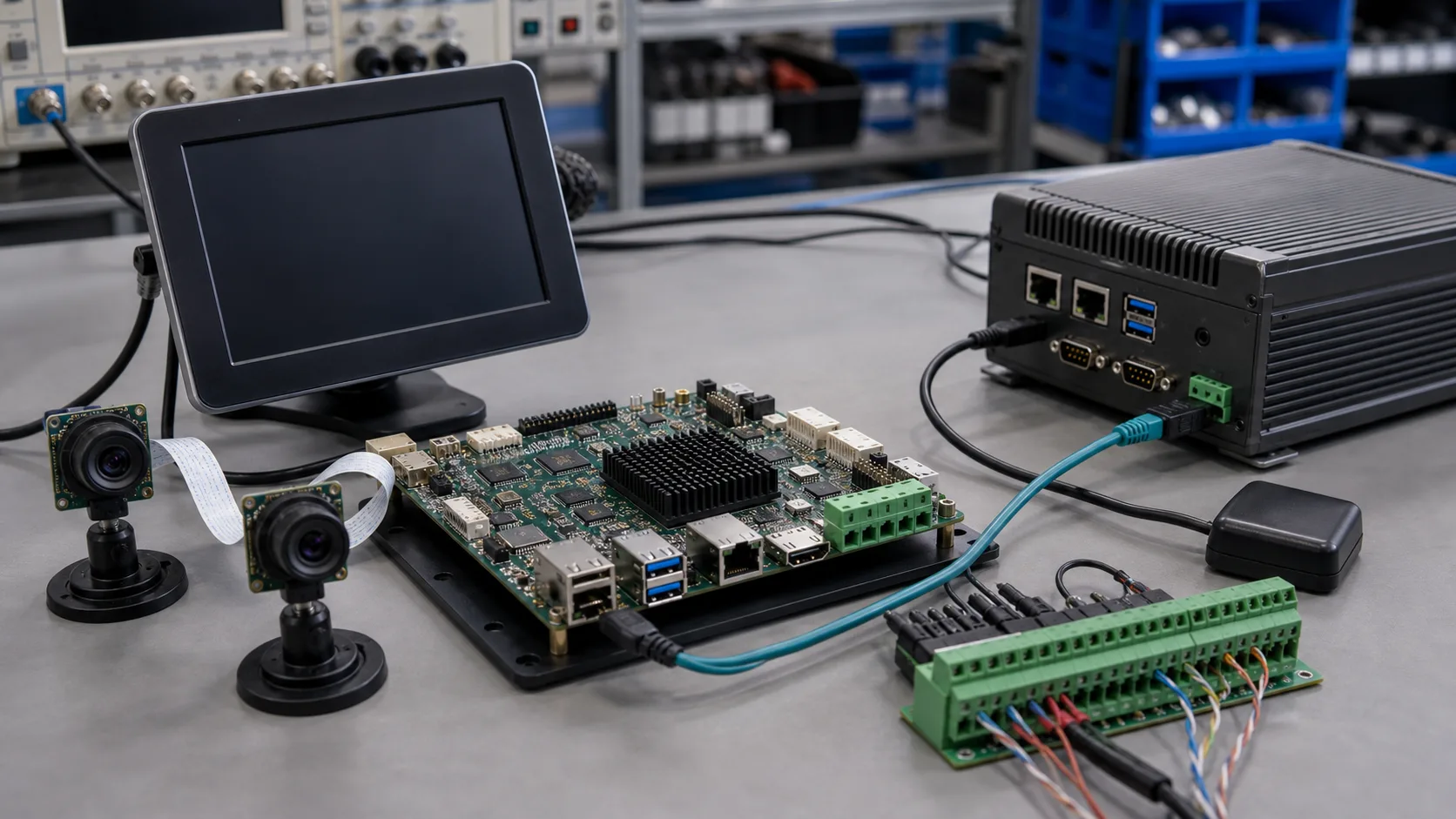
NXP i.MX8M Plus is one of the more credible ARM platforms for industrial products that need vision, machine learning, multimedia, and long-term reliability without moving into high-power x86 territory. It is not the fastest ARM SoC on the market, but speed is not the only reason engineers choose it. The platform is attractive because it combines Cortex-A53 application cores, a Cortex-M7 real-time core, NPU acceleration, dual image signal processors, CAN FD, dual Gigabit Ethernet with TSN support on selected interfaces, and industrial temperature options.
That mix is important. Industrial systems rarely need only a CPU. They need deterministic I/O, camera input, display output, power management, secure boot, update strategy, field diagnostics, and a software vendor that can support the product for years.
Why i.MX8M Plus Fits Industrial Projects
NXP positions i.MX8M Plus for machine learning, vision, multimedia, and industrial IoT. Official NXP product information lists dual or quad Cortex-A53 options up to 1.8 GHz, a Cortex-M7 core, an NPU up to 2.3 TOPS, dual ISPs, two MIPI CSI camera inputs, CAN FD, dual Gigabit Ethernet with TSN capability, DDR inline ECC, and industrial temperature support up to -40 C to 105 C junction depending on SKU and package.
For a product manager, that means i.MX8M Plus can cover several industrial product types without forcing a full x86 design:
| Application | Why i.MX8M Plus fits |
|---|---|
| Machine vision | Dual camera input, ISP, NPU, Linux support |
| Industrial HMI | Display output, GPU, multimedia, touch UI support |
| Edge gateway | Ethernet, CAN FD, Linux, security features |
| Robotics controller | Cortex-M7 for real-time assist, camera and ML support |
| Smart building device | Low power, audio, vision, long-life embedded positioning |
Machine Vision and Inspection
The strongest use case is compact vision. i.MX8M Plus can receive camera data, process images through ISP blocks, and run moderate ML inference locally. That makes it suitable for barcode reading, object presence checks, people counting, basic defect detection, and vision-assisted automation.
It is not a replacement for a workstation GPU or high-end AI accelerator. If the requirement is multi-camera 4K inference at high frame rate, the platform will be constrained. But many industrial vision tasks are not that large. A common product goal is more modest: one or two cameras, controlled lighting, a known object class, and a decision that must be made locally without relying on a cloud server.
For EEAT-style engineering content, the important recommendation is to measure the full pipeline, not only NPU TOPS. Camera capture, ISP tuning, memory copies, pre-processing, inference, post-processing, and application logic all contribute to latency. A model that benchmarks well as a standalone file may underperform once it is integrated with a real camera and UI, which is why the industrial SBC machine vision decision has to include lighting, camera interface, storage, and recovery behavior.
HMI Panels and Operator Interfaces
i.MX8M Plus is also a practical HMI platform. Many factories need touch panels that show machine status, trends, alarms, recipes, and maintenance screens. These systems often run Linux/Qt, Android, Chromium-based kiosks, or vendor HMI software.
The platform’s multimedia and display capabilities help with responsive interfaces, video preview, and local dashboards. The CPU is not excessive, so developers should avoid bloated UI stacks when possible. A carefully built Qt or native Linux application can feel more stable over years than a heavy web application with uncontrolled memory growth. For operator panels, the same display, touch, boot, and update questions appear in industrial SBC design for HMI panels.
For HMI work, the most important design checks are:
- display interface and resolution support
- touch controller driver support
- GPU acceleration in the chosen OS image
- boot time from cold power
- watchdog recovery after UI process failure
- storage endurance for logs and recipes
- screen burn-in policy for fixed UI elements
Gateways, CAN FD, and TSN Ethernet
Many industrial gateways sit between field devices and higher-level software. They translate CAN, serial, Ethernet, MQTT, OPC UA, Modbus, or vendor-specific protocols. i.MX8M Plus is useful here because it is not only a multimedia SoC. It includes industrial connectivity features that matter in control-adjacent products.
CAN FD support is useful for motor drives, vehicles, battery systems, and equipment networks. Dual Gigabit Ethernet can support separation between machine networks and plant networks. TSN capability matters when the design requires better time coordination, although TSN is never just a hardware checkbox. Switches, drivers, kernel configuration, clocking, and application behavior must be validated together.
The Cortex-M7 core can be used for real-time assist, but it should not be treated as magic. Partitioning work between Linux and the M7 requires firmware design, shared memory planning, update logic, and debugging tools. Use it when there is a real need for deterministic side tasks, not because it sounds good in a feature list.
Reliability and Lifecycle
NXP platforms are often chosen for lifecycle reasons. In industrial products, the ability to buy compatible processors for years can be more valuable than a benchmark advantage. DDR inline ECC support also improves the reliability story for systems exposed to heat, electrical noise, or long uptime.
That does not remove the need for product validation. A reliable i.MX8M Plus system still needs:
| Validation area | What to test |
|---|---|
| Thermal | Full load at max ambient, sealed enclosure, sun exposure if outdoor |
| Storage | Power-cut behavior, write endurance, filesystem recovery |
| Networking | Cable removal, DHCP failure, time sync drift, packet bursts |
| Camera | Disconnect, exposure changes, lighting variation, frame drops |
| Updates | A/B rollback, signed images, failed update recovery |
Software Stack
The platform can run Linux, Android, Windows IoT in some vendor contexts, and FreeRTOS for the real-time side. For most industrial SBC projects, Linux is the default because it gives the best balance of networking, field updates, security tooling, and long-term maintainability.
The decision is usually not “Linux or Android” but “which vendor BSP can we support for five years?” A board vendor with clear kernel branches, Yocto layers, security update policy, and camera/display documentation is worth more than a cheaper board with a one-time image download.
Recommendation
Use i.MX8M Plus when you need a balanced industrial ARM platform for vision, HMI, gateway, and moderate edge AI. It is especially attractive when industrial temperature, ECC, CAN FD, Ethernet, camera input, and long-term vendor support matter more than maximum benchmark performance.
Avoid it if your product needs heavy multi-camera AI, desktop-class UI rendering, or large local analytics workloads. In those cases, RK3588, NVIDIA Jetson-class modules, or embedded x86 may be better.
Source Notes
NXP’s official i.MX8M Plus product page describes the processor family as targeting machine learning, vision, multimedia, and industrial IoT. It lists Cortex-A53 application cores, Cortex-M7, an NPU up to 2.3 TOPS, dual ISPs, MIPI CSI, CAN FD, dual Gigabit Ethernet with TSN capability, DDR inline ECC, Linux and Android support, and industrial temperature options. Final product behavior still depends on the specific SBC or module design.