
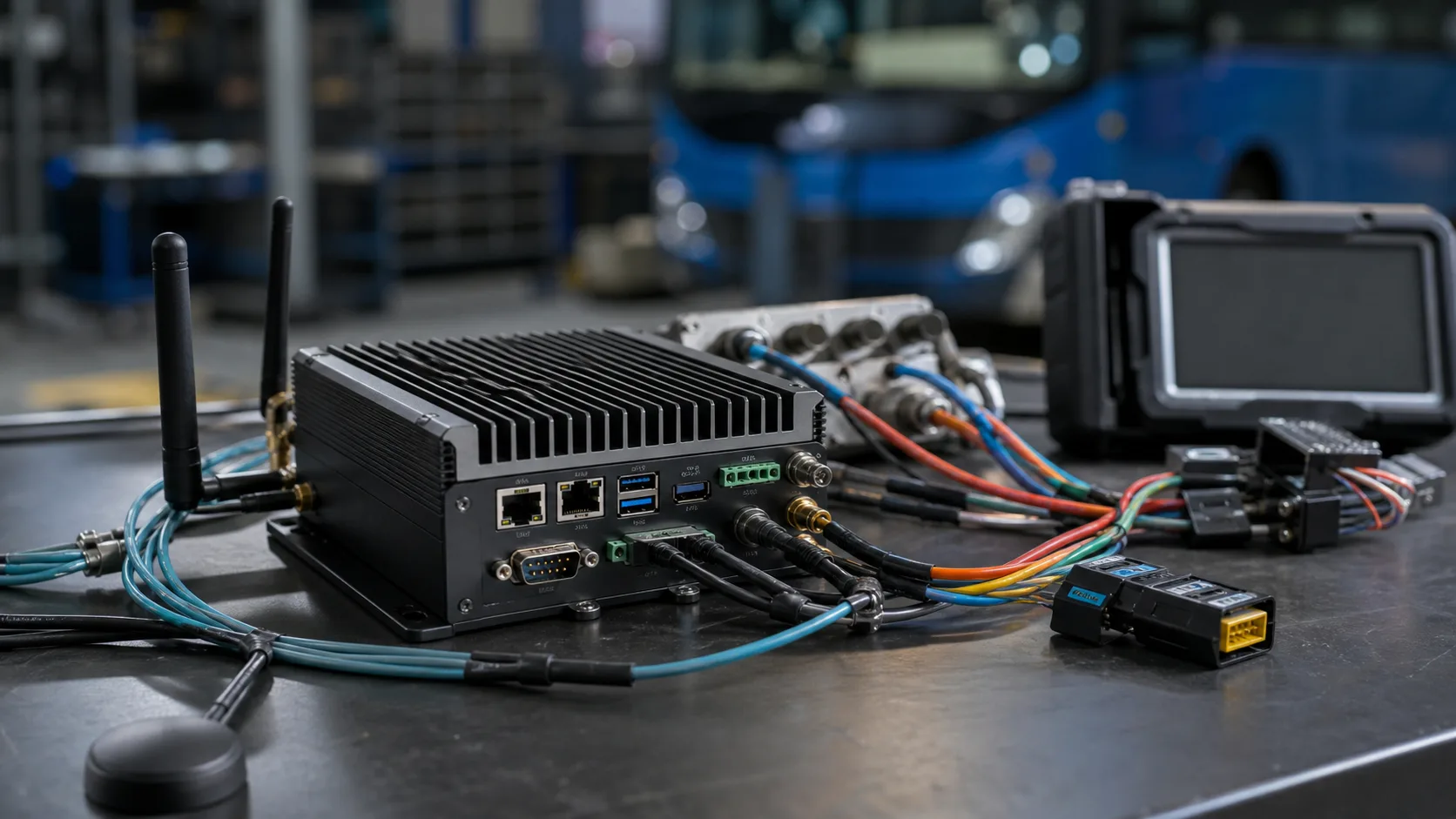
Smart transportation systems place unusual demands on industrial SBCs. A device may be installed in a bus, train, truck, roadside cabinet, parking system, charging station, or traffic monitoring unit. It may face vibration, heat, cold, ignition power events, poor network connectivity, dust, moisture, and sudden power loss. A board that works in a lab may not survive in a vehicle or outdoor enclosure.
The right industrial SBC for transportation is not simply the fastest board. It is the board that can tolerate the electrical and mechanical environment while running the required software reliably.
Common Transportation Use Cases
| Use case | Typical SBC workload |
|---|---|
| Fleet gateway | CAN, GNSS, LTE/5G, MQTT, local logging |
| Passenger information | Display output, media playback, remote updates |
| Video surveillance | Camera capture, storage, network upload |
| Traffic monitoring | Edge AI, camera input, event detection |
| EV charging controller | Payment UI, power monitoring, network backend |
| Rail or bus diagnostics | Fieldbus, serial, Ethernet, rugged storage |
Each use case has a different priority. A passenger display values media and update reliability. A fleet gateway values CAN, GNSS, ignition control, and cellular recovery. A roadside AI camera values thermal design, vision performance, and network resilience.
Power Input and Ignition Behavior
Transportation power is messy. Vehicle systems can have voltage dips, cranking events, load dumps, reverse polarity, and noise. Roadside cabinets may have surges and outages. The SBC or carrier board should not expect clean 5 V USB power.
For vehicle products, check:
- wide input voltage range
- ignition sense
- delayed shutdown
- reverse polarity protection
- load dump protection
- low-voltage cutoff
- watchdog restart
- safe shutdown for storage
If the board does not include these features, the product needs a proper power management front end.
Vibration and Mechanical Design
Transportation devices need secure connectors. HDMI, USB, and microSD can be problematic if they are not retained. Use locking connectors where possible. Prefer soldered eMMC or industrial SSDs over removable cards. Use mounting hardware that supports vibration.
The enclosure should protect the board and create a thermal path. A metal case can help with both heat and EMI. Cable strain relief matters. A field failure caused by a loose connector looks like a software bug until someone opens the box.
Connectivity: CAN, GNSS, LTE, and Ethernet
Transportation SBCs often need multiple communication paths:
| Interface | Purpose |
|---|---|
| CAN or CAN FD | Vehicle data, battery systems, diagnostics |
| RS-232/RS-485 | Legacy devices, ticketing, sensors |
| GNSS | Position, time, fleet tracking |
| LTE/5G | Cloud connectivity |
| Wi-Fi | Depot updates or local service |
| Ethernet | Cameras, switches, charging controllers |
Linux support for these interfaces must be validated. For cellular modules, test SIM handling, reconnect behavior, poor signal recovery, and carrier certification requirements. For GNSS, test cold start, antenna placement, and time synchronization. CAN and serial-heavy designs should also be checked against the electrical and Linux details in RS-232, RS-485, and CAN bus for industrial SBCs.
Cameras and Edge AI
Smart transportation increasingly uses cameras: driver monitoring, passenger counting, lane monitoring, license plate recognition, traffic flow, and security. Camera workloads can push the SBC beyond simple gateway requirements.
For camera-heavy systems, evaluate:
- number of cameras
- interface type: USB, MIPI, GigE, GMSL
- recording requirements
- AI model size
- night performance
- storage capacity
- privacy requirements
- thermal load during continuous capture
An RK3568-class board may be enough for a gateway with one camera preview. RK3588, i.MX8M Plus, Jetson-class modules, or embedded x86 may be needed for stronger AI or multi-camera systems.
Storage and Data Integrity
Transportation systems often run unattended and experience sudden power loss. Logging is critical for diagnostics and compliance. Storage must handle vibration, temperature, and power interruptions.
Use industrial eMMC or SSDs. Avoid consumer microSD cards for production. Implement log rotation and avoid writing excessive debug data. If video is stored locally, calculate endurance carefully. A system recording continuously can wear out storage much faster than expected.
Thermal and Environmental Requirements
Vehicle interiors can become very hot. Roadside cabinets can freeze in winter and overheat in summer. If the product needs wide-temperature operation, verify the entire system: CPU, memory, storage, modem, power supply, connectors, and display. Harsh outdoor and vehicle environments make wide temperature SBC design a system qualification problem, not just a component rating.
Thermal testing should include cellular transmission, GNSS, camera load, storage writes, and CPU load. Cellular modules can add significant heat during poor signal conditions because they transmit at higher power.
Software Recovery
Transportation devices should recover without a technician. Network loss is normal. Power loss is normal. GPS loss is normal. The application should queue data, retry, and report health when connectivity returns.
Useful software features include:
- watchdog
- A/B updates
- signed firmware
- local event buffer
- remote logs
- modem reset control
- service-mode access
- time sync fallback
Data Ownership and Privacy
Transportation systems can collect sensitive information: vehicle location, driver behavior, passenger counts, license plates, video, payment events, and maintenance records. The SBC design should define what is processed locally, what is stored, what is transmitted, and how long data is retained. Edge processing can reduce privacy risk by sending events instead of raw video, but only if the software is designed that way from the start.
For camera systems, consider masking, event-only recording, encryption at rest, and role-based access to stored clips. For fleet systems, protect GNSS traces and diagnostic data because they can reveal routes and operations. These are not only legal concerns. They affect customer trust and service contracts.
Maintenance in the Field
A transportation SBC should be easy to diagnose without removing the vehicle from service. Provide clear status LEDs, remote logs, a service port or secure local access method, and a documented replacement process. If the device uses a modem, make sure service teams can distinguish between a modem failure, SIM issue, antenna issue, and backend outage.
Fleet deployments also need configuration management. A gateway installed in one bus may require different CAN parameters, route settings, or reporting intervals than another. Store configuration separately from firmware so updates do not erase site-specific settings.
Recommendation
Choose an industrial SBC for transportation based on environment first, performance second. For fleet gateways, prioritize power input, CAN, GNSS, modem support, and storage reliability. For passenger information, prioritize display and update behavior. For transportation vision, prioritize camera pipeline, AI acceleration, storage endurance, and thermals.
The strongest product is usually built around a board or system designed for vehicle or outdoor deployment, not a generic SBC placed inside a box. In transportation, rugged integration is the difference between a pilot project and a maintainable fleet.
Source Notes
NXP lists industrial and transportation-adjacent applications for i.MX processors, including fleet management and vision systems. Many Rockchip, Intel, and AMD embedded boards are used in transportation gateways and HMIs, but the decisive factors are power design, connectivity, mechanical ruggedness, and validated software recovery.