
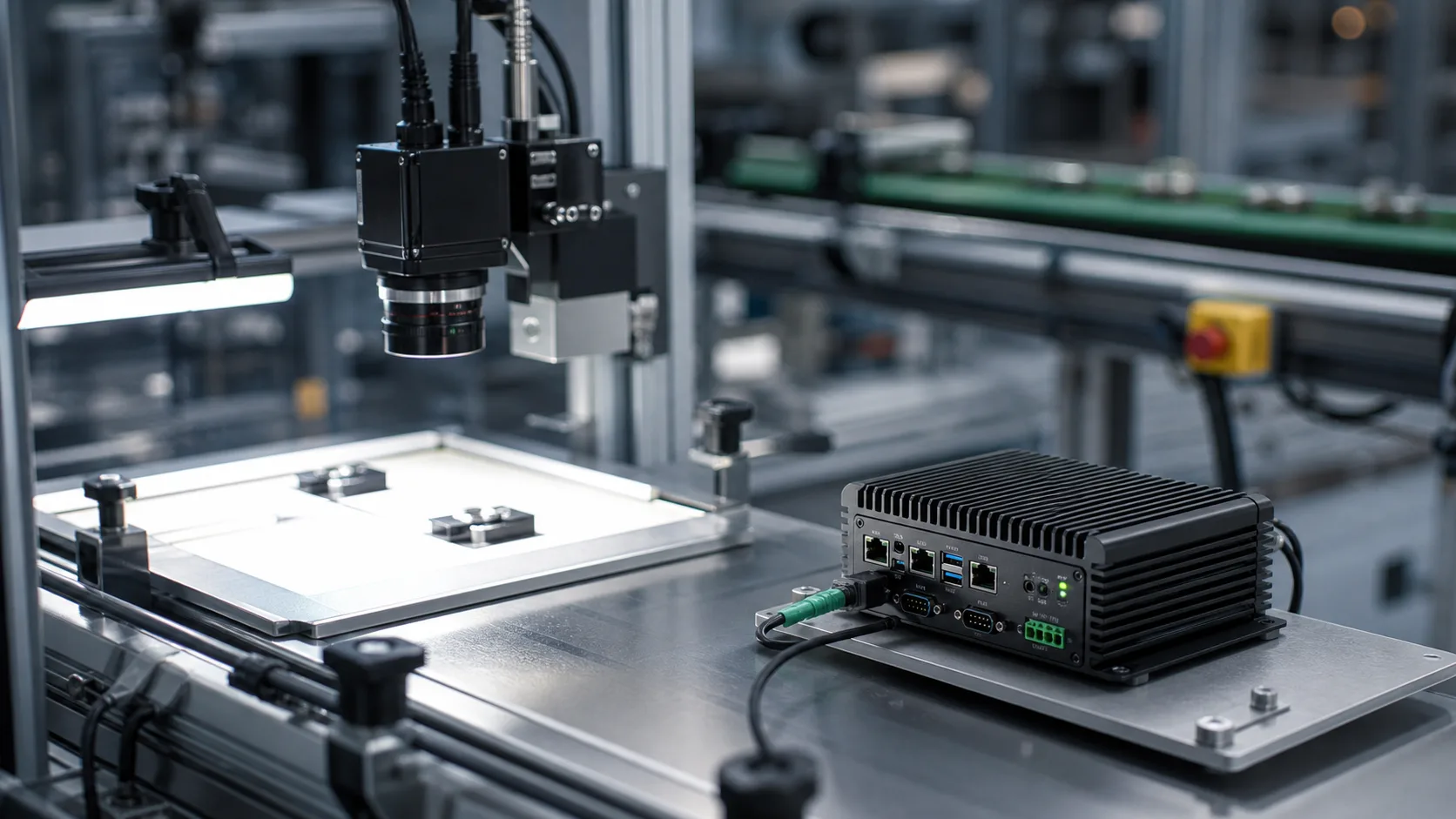
Machine vision is one of the hardest workloads for an industrial SBC because it stresses the entire system at once. A vision device may need camera capture, image signal processing, inference, logging, networking, user interface, storage, and remote management. If any part of the pipeline is weak, the product may work in a demo but fail on a production line.
Choosing an industrial SBC for machine vision should start with the inspection problem, not the processor. A presence check under controlled lighting is very different from defect detection on reflective metal, high-speed motion, or multi-camera sorting. The right board depends on camera type, frame rate, model size, latency target, environmental conditions, and how the result is used by the machine.
Define the Vision Workload First
Before comparing SBCs, write down the actual workload:
| Requirement | Example |
|---|---|
| Camera count | 1 USB camera, 2 MIPI cameras, or 4 GigE cameras |
| Resolution | 720p, 1080p, 5MP, 12MP |
| Frame rate | 5 FPS inspection, 30 FPS tracking, 60 FPS motion |
| Algorithm | Rule-based, classical CV, AI detection, segmentation |
| Latency | Display only, alarm within 500 ms, reject within 50 ms |
| Output | GPIO, relay, Ethernet command, database record, image archive |
| Environment | Dust, vibration, heat, lighting variation |
This table prevents a common mistake: buying an AI-capable SBC without knowing whether the bottleneck is actually camera exposure, lens quality, memory copies, storage writes, or lighting.
Camera Interface Choices
Camera interface drives platform selection. USB cameras are easy to prototype and widely supported, but cable retention and bandwidth can become issues. MIPI CSI cameras offer compact integration and low overhead, but they depend heavily on board support and driver tuning. GigE cameras are common in industrial vision because they support longer cables and established machine vision ecosystems, but they require network bandwidth and sometimes vendor SDKs.
| Interface | Strength | Weakness |
|---|---|---|
| USB | Easy development, many cameras | Cable reliability, shared bus limits |
| MIPI CSI | Compact, efficient, low power | Driver and sensor tuning required |
| GigE Vision | Long cable, industrial cameras | Higher system cost, network tuning |
| GMSL/FPD-Link | Automotive/robotics distance | More complex hardware design |
For production systems, do not choose a camera only because it works in the lab. Check lens mount, enclosure sealing, cable lock, trigger support, exposure control, lighting sync, and vendor lifecycle.
CPU, GPU, NPU, and Accelerator Balance
Machine vision performance is not determined by TOPS alone. The SBC needs enough CPU for camera handling, pre-processing, decision logic, networking, and recovery. The GPU may help with display or OpenCL/Vulkan workloads. The NPU may accelerate neural networks, but only if the model converts cleanly and the runtime supports the required operators.
For simple inspection, an ARM SBC such as RK3568 or NXP i.MX8M Plus in industrial vision and HMI products may be enough. For stronger AI and multi-stream work, RK3588, NVIDIA Jetson-class modules, AMD Ryzen Embedded, or Intel platforms with accelerators may be more appropriate. For Windows-based machine vision SDKs, x86 can reduce integration risk. AI-heavy systems should still be specified like an edge AI gateway, with model conversion, thermals, storage, and recovery tested together.
Storage and Image Logging
Many vision systems need to store failed images, audit trails, production counts, or short video clips. Storage load can surprise teams. A system that only stores one JPEG per minute has very different requirements from a system that records full-resolution frames for traceability.
Use eMMC for simple logs and application storage. Use industrial NVMe or SATA SSDs when writing many images. Avoid consumer microSD cards in production vision systems. If the device can lose power during writes, test filesystem recovery and database integrity; this is where the eMMC vs NVMe trade-off for embedded systems becomes a reliability decision, not only a speed decision.
Lighting and Real-World Reliability
Good lighting can reduce compute requirements more than a faster processor. Controlled light, fixed exposure, proper lens selection, and mechanical alignment improve accuracy and reduce model complexity. Many failed AI vision projects are actually lighting projects in disguise.
Industrial SBC selection should include I/O for lighting control: GPIO, trigger output, serial control, or Ethernet. If inspection depends on strobe timing, verify latency and jitter. A Linux application can be reliable for many tasks, but strict microsecond timing may need external trigger hardware or a microcontroller.
Thermal Design
Vision workloads are often sustained. A benchmark that runs for two minutes is not enough. Run the camera, inference engine, UI, network upload, and storage writes for a full shift. Measure SoC temperature, SSD temperature, enclosure temperature, and throttling behavior.
Fanless vision systems are possible, but only with a real thermal path. In a dusty factory, fans may reduce reliability. In a sealed metal enclosure, heat spreading is mandatory. In a plastic enclosure, high-performance SoCs may be inappropriate.
Validation Checklist
| Test | Pass condition |
|---|---|
| 8-hour continuous capture | No dropped camera, no memory growth |
| Worst-case lighting | Accuracy remains within target |
| Network disconnect | System buffers or recovers gracefully |
| Power cut during write | Filesystem and database recover |
| Thermal soak | No throttling that breaks latency target |
| Bad part burst | Reject decisions still meet timing |
| Camera unplug/replug | Application recovers without reboot if required |
Platform Recommendations
For rule-based single-camera inspection, a moderate ARM SBC can work well. For AI-assisted inspection with one or two cameras, i.MX8M Plus or RK3588-class platforms are reasonable candidates. For heavier models, multi-camera analytics, or Windows machine vision software, embedded x86 or accelerator-based systems may be safer.
The best industrial SBC for machine vision is the one that passes the full pipeline test. Do not buy only for CPU frequency or NPU TOPS. Buy for camera support, thermal margin, storage reliability, software maintainability, and the ability to recover from real factory failures.
Source Notes
NXP positions i.MX8M Plus for machine learning, vision, multimedia, and industrial IoT, including dual camera input and NPU acceleration. Rockchip RK3588 boards are commonly positioned by vendors for higher-performance edge AI and video applications. Final system suitability depends on the board, camera, driver stack, enclosure, and validation process.