
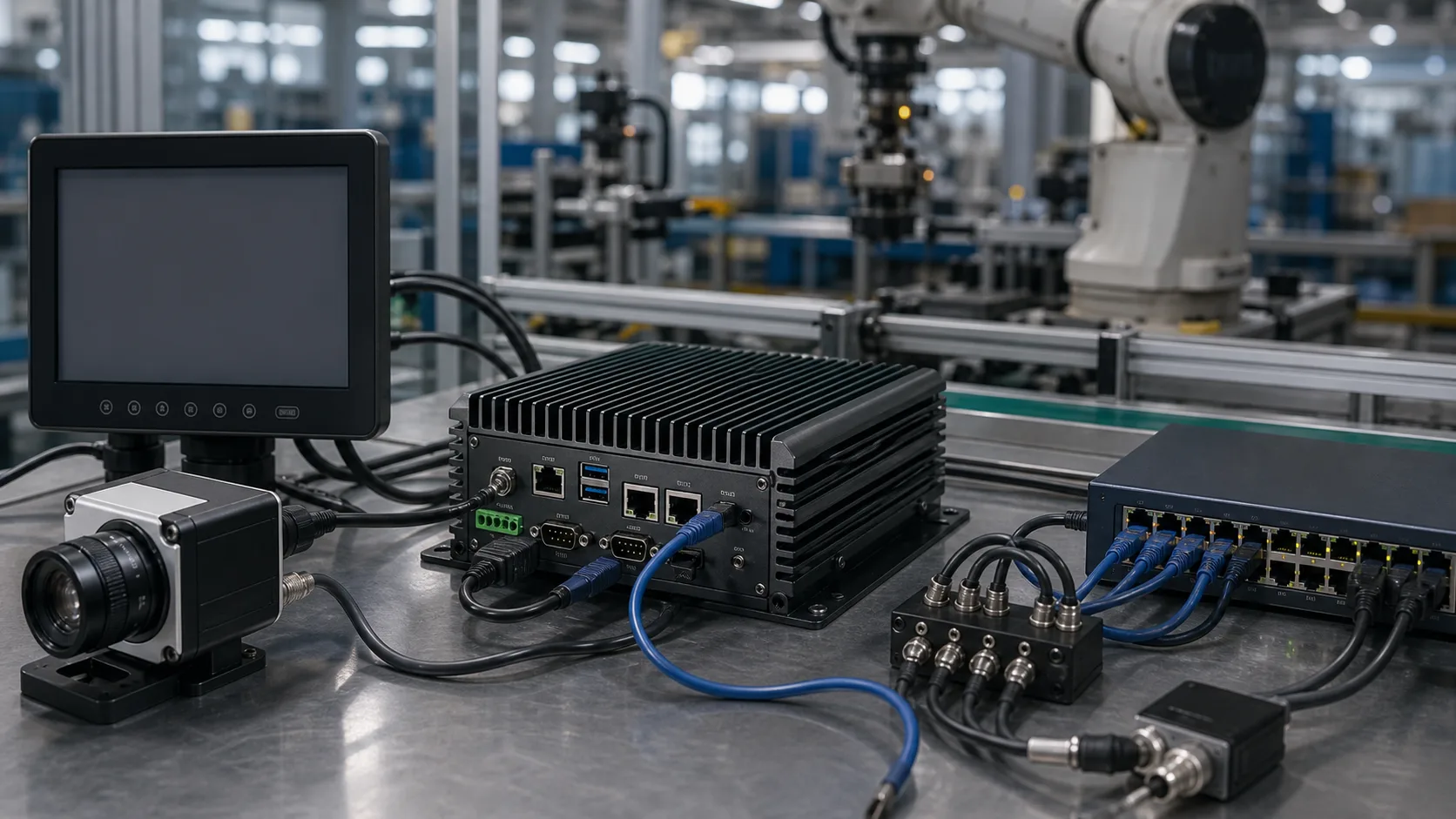
An edge AI gateway is not just an AI accelerator in a box. It is a system that collects data, runs local inference, filters events, communicates with machines or sensors, stores evidence, and synchronizes with cloud or factory software. The industrial SBC at the center of that gateway must be reliable before it is intelligent.
The best platform depends on the input data. A gateway analyzing vibration signals has different needs from one processing camera streams. A device classifying sensor events over MQTT may run on a modest ARM board. A gateway performing video analytics may need RK3588, i.MX8M Plus, NVIDIA Jetson, AMD Ryzen Embedded, Intel Core, or an external accelerator.
Define the Edge AI Role
| Gateway role | Typical workload |
|---|---|
| Sensor anomaly detection | Time-series inference, low data rate |
| Camera event detection | Image capture, pre-processing, NPU/GPU inference |
| Audio monitoring | DSP or CPU processing, model inference |
| Protocol intelligence | Rule engine plus small models |
| Fleet gateway | Local filtering before cloud upload |
| Safety-adjacent monitoring | Deterministic reporting and conservative fallback |
Do not start with “we need 6 TOPS.” Start with input type, sample rate, model size, latency, event output, and failure behavior.
CPU, GPU, NPU, or External Accelerator
Edge AI platforms often advertise NPU performance, but the complete pipeline matters. The CPU handles drivers, pre-processing, post-processing, networking, logging, and application logic. The GPU may accelerate graphics or compute. The NPU accelerates supported neural networks, but model conversion can be the difficult part.
| Compute option | Strength | Risk |
|---|---|---|
| CPU only | Simple deployment, portable | Lower performance per watt |
| Integrated NPU | Efficient inference | Toolchain/operator limits |
| Integrated GPU | Flexible for some workloads | Driver/runtime complexity |
| External accelerator | More performance | BOM, thermal, driver, supply risk |
For long-life industrial products, toolchain stability is as important as peak performance. If the model must be updated in the field, the conversion process should be repeatable and documented.
Model Deployment Workflow
A practical edge AI workflow looks like this:
Train model -> export model -> convert for runtime -> validate accuracy -> benchmark latency -> thermal soak -> deploy with rollback
Each arrow can hide engineering work. Quantization may reduce accuracy. Runtime conversion may fail on unsupported operators. Pre-processing differences can change results. A model that runs well on a development PC may behave differently on an ARM NPU.
Keep a versioned model registry, record test datasets, and store conversion scripts. That is part of EEAT in engineering practice: future maintainers must understand how the deployed model was produced.
I/O and Data Collection
Edge AI gateways often connect to multiple data sources:
- cameras
- microphones
- vibration sensors
- PLCs
- serial devices
- CAN devices
- Ethernet sensors
- cloud APIs
The SBC should have the right physical I/O, but also the right software support. A gateway that depends on USB adapters for everything may be fragile. For industrial use, native Ethernet, isolated serial, CAN transceivers, and stable power input are preferable, especially when RS-232, RS-485, or CAN bus interfaces sit between the AI gateway and field equipment.
Storage and Evidence
AI gateways often need to store evidence: images around an event, sensor windows, inference results, logs, and model versions. Storage planning should include write endurance and privacy.
For camera-based gateways, define:
| Storage item | Retention |
|---|---|
| Event image | Days or weeks |
| Full video | Usually short retention due to size |
| Metadata | Longer retention, low volume |
| Model files | Versioned and signed |
| Logs | Rotated and compressed |
If the gateway operates offline, it must buffer data safely and synchronize later.
Security and Updates
An edge AI gateway often has network access and may process sensitive data. Security cannot be added at the end. Use secure boot where available, signed updates, unique device credentials, firewall rules, and least-privilege services.
AI model updates should follow the same discipline as firmware updates. A bad model can break production behavior even if the OS is fine. Use staged rollout, rollback, and metrics.
Data Reduction Strategy
One of the strongest reasons to put AI at the edge is to reduce data movement. Instead of sending every frame, waveform, or sensor sample to a server, the gateway can send events, summaries, and small evidence packages. That lowers bandwidth cost and makes the system more resilient when the network is unreliable.
The reduction strategy should be explicit:
| Raw input | Edge output |
|---|---|
| Full camera stream | Event image plus timestamp and confidence |
| Vibration waveform | Anomaly score and short diagnostic window |
| Audio sample | Detected class and duration |
| PLC data | State transition and exception report |
This design also improves privacy because less raw data leaves the site. However, it creates a new requirement: the gateway must store enough context to explain why an event was triggered. Without that evidence, operators may not trust the AI system.
Observability
AI gateways need more than system logs. They should report model version, inference latency, queue depth, dropped frames, accelerator utilization, temperature, storage usage, and network state. These metrics make it possible to know whether accuracy problems are caused by the model, the camera, lighting, thermal throttling, or upstream data quality.
Thermal Validation
AI workloads are sustained and bursty. A device may sit idle for hours, then process events continuously. Test both. NPU load can heat the SoC, but so can camera modules, SSDs, LTE modems, and power regulators.
The validation target should be system behavior:
- inference latency under heat
- frame drops during network upload
- CPU usage during pre-processing
- storage temperature during event bursts
- recovery after model process crash
- enclosure temperature at maximum ambient
Platform Recommendations
For time-series AI or simple anomaly detection, a moderate ARM SBC may be enough. For vision AI, i.MX8M Plus is a good industrial candidate for modest workloads, while RK3588 offers more headroom. For Windows AI software or mixed CPU/GPU workloads, embedded x86 may be useful. For heavy neural networks, use a dedicated accelerator platform. If the gateway is mainly camera-based, the industrial SBC machine vision checks for camera, storage, lighting, and recovery become part of the gateway specification.
Recommendation
Choose an industrial SBC for edge AI gateway work by validating the complete pipeline. The right platform is not the one with the largest AI number. It is the one that can collect data reliably, run the model repeatably, recover from faults, update safely, and stay within thermal limits.
Source Notes
NXP i.MX8M Plus official documentation emphasizes machine learning, vision, multimedia, and industrial IoT with an integrated NPU. Rockchip RK3588-based boards are commonly used for stronger AI and vision workloads. Intel and AMD embedded x86 platforms are useful when software compatibility or GPU-assisted workloads are more important than ARM power efficiency.