
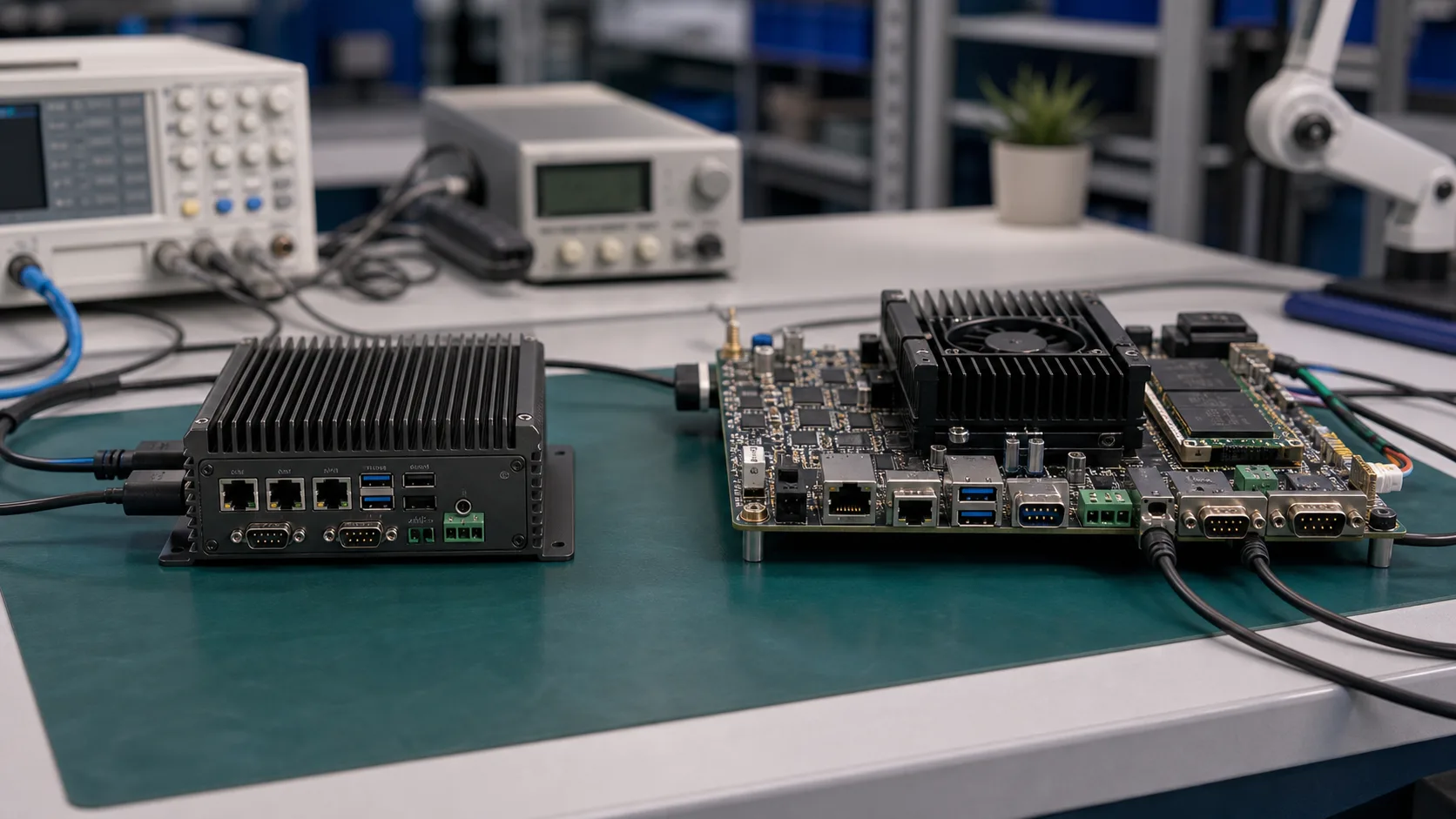
AMD Ryzen Embedded V2000 and R2000 platforms both target embedded systems that need x86 compatibility, Radeon graphics, and long-life product availability. They are often considered for industrial PCs, edge computers, digital signage players, medical consoles, thin clients, and HMI systems. The difference is not only performance. The right choice depends on workload size, graphics requirements, thermal envelope, I/O, cost target, and how much margin the product needs over its service life.
In simple terms, Ryzen Embedded V2000 is the higher-performance option. Ryzen Embedded R2000 is the more moderate platform for compact, lower-power systems that still need modern x86 and graphics capability.
Quick Comparison
| Area | Ryzen Embedded R2000 | Ryzen Embedded V2000 |
|---|---|---|
| Product position | Mainstream embedded x86 | Higher-performance embedded x86 |
| Typical systems | HMIs, thin clients, signage, gateways | Vision PCs, multi-display systems, edge analytics |
| CPU headroom | Moderate | Stronger multi-core headroom |
| Graphics | Good integrated Radeon graphics | Stronger graphics and display capability depending on SKU |
| Power/thermal | Easier to cool in compact systems | More thermal planning required |
| Best fit | Balanced cost and capability | Performance-sensitive industrial computers |
CPU and Workload Fit
R2000 is suitable for embedded systems that need responsive x86 performance but do not run heavy analytics. Examples include operator terminals, smart kiosks, light gateways, medical device interfaces, and digital signage controllers. It is a good choice when the system must run Windows or x86 Linux software but does not need workstation-class compute.
V2000 gives more margin for multi-threaded workloads. It is better for systems that run several services at once: UI, logging, network synchronization, local database, video processing, remote management, and perhaps light AI pre-processing. In industrial design, margin matters because the software load often grows after the first release. New dashboards, security agents, telemetry services, and customer-specific integrations can slowly consume CPU.
Graphics and Display
One reason engineers choose AMD Embedded platforms is integrated Radeon graphics. For HMI and signage, this matters. Smooth video decode, multiple displays, GPU-accelerated UI, and high-resolution output can reduce the need for a discrete GPU. When the graphics workload also includes local AI or video analytics, AMD Ryzen Embedded SBCs at the edge are often evaluated as complete CPU/GPU platforms rather than simple x86 boards.
R2000 is usually enough for single or dual display systems with moderate UI complexity. V2000 is better when the product needs more display outputs, higher resolution, video walls, GPU-assisted visualization, or more demanding multimedia behavior.
For industrial HMIs, graphics should be evaluated differently from consumer PCs. The question is not “can it play a benchmark?” The question is whether the system remains smooth after 30 days of uptime, with the real application running, logs writing, and remote monitoring enabled.
Thermal Design
Thermals are where many x86 embedded projects succeed or fail. R2000 can be easier to integrate into fanless enclosures because the performance target is more moderate. V2000 can also be used fanless in the right system, but it needs a stronger thermal path and more careful power configuration. The platform choice should therefore be tied directly to fanless industrial computer thermal design, not evaluated only from CPU benchmarks.
Use this rough decision table:
| Enclosure condition | Better starting point |
|---|---|
| Small sealed box, no airflow | R2000 |
| Metal chassis with good heat spreading | R2000 or V2000 |
| Multi-display industrial PC | V2000 |
| Vision box with sustained CPU/GPU load | V2000, possibly active cooling |
| Cost-sensitive HMI | R2000 |
Do not rely only on processor TDP. System power includes memory, storage, Ethernet controllers, USB devices, display backlight, power conversion losses, and wireless modules. A fanless thermal test should include all of them.
I/O and Board-Level Differences
The final industrial product depends heavily on the carrier board or SBC. Both R2000 and V2000 systems can expose Ethernet, USB, SATA, NVMe, serial ports, GPIO, audio, and display outputs, but the exact implementation varies.
Check:
- how many displays are supported at the required resolution
- whether Ethernet ports are native PCIe controllers
- whether the board supports TPM and secure boot
- whether serial ports support RS-232/422/485 modes
- whether expansion slots share lanes with storage or LAN
- whether the vendor documents BIOS settings for watchdog and power recovery
Industrial buyers should ask for block diagrams. A block diagram reveals whether a design is clean or whether too many devices share one bottleneck.
Software Support
Both platforms are attractive when the software stack depends on Windows, x86 Linux, AMD graphics drivers, or existing PC-based applications. AMD Embedded can be especially useful where UI and graphics matter more than raw single-thread CPU performance.
Still, driver maturity must be validated in the exact OS version. A platform that works well on a vendor image may behave differently after a kernel update or Windows feature update. For long-life products, freeze the software baseline and define an update policy.
Use Cases
R2000 is a good fit for:
- industrial HMI terminals
- retail signage players
- compact gateways with x86 requirements
- thin-client style systems
- medical or lab interfaces
- dual-display control panels
V2000 is a better fit for:
- multi-display digital signage
- machine vision front ends
- local analytics boxes
- richer HMI systems
- GPU-assisted visualization
- edge systems with multiple containers
Cost and Lifecycle
The cheaper processor is not always the cheaper product. If R2000 forces a redesign later because the software grows beyond its margin, V2000 may have been cheaper over the lifecycle. Conversely, choosing V2000 for a simple HMI can increase power, enclosure cost, and BOM without improving the customer experience.
The practical approach is to define a five-year workload forecast. Include the current application, planned features, security agents, logging growth, remote management, and customer customization. If R2000 still has margin, use it. If not, start with V2000.
Recommendation
Choose Ryzen Embedded R2000 for balanced systems where x86 compatibility and Radeon graphics are needed but thermal and cost control are important. Choose Ryzen Embedded V2000 when the product needs more CPU/GPU headroom, richer displays, analytics, or longer performance margin.
For industrial products, the final answer should come from a real workload test. Run your application for days, not minutes. Measure CPU clocks, skin temperature, memory use, GPU load, disk writes, and UI latency. That is the difference between a benchmark choice and a field-ready platform choice, especially when the shortlist also includes Intel systems and the project becomes an Intel vs AMD embedded board decision.
Source Notes
AMD positions Ryzen Embedded processors for long-life embedded systems that need x86 CPU performance and integrated Radeon graphics. V2000 is generally used in higher-performance embedded designs, while R2000 is positioned for mainstream embedded systems. Final capabilities depend on SKU, board design, firmware, cooling, and vendor software support.